


Bringing Charlotte Baldwin Allen to Life in Bronze
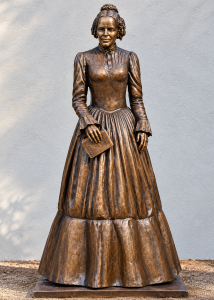
There are certain sculptures that become more than a commission. They become a journey.
Creating the bronze sculpture of Charlotte Marie Baldwin Allen, one of the women who helped shape the early history of Houston, was one of those projects for me.
I was honored to be commissioned to bring Charlotte Baldwin Allen back into the public eye through sculpture—a woman whose story is remarkable, yet whose face has been largely absent from the visual history of the city she helped build.
For me, this was not simply about creating a statue. It was about giving a woman from Houston’s past a face, a presence, and a permanent place in the city she helped shape.
The Challenge of Sculpting a Woman I Could Not Truly See
One of the first things I discovered when I began the project was how little photographic reference existed of Charlotte.
As a portrait sculptor, I am accustomed to studying a subject from many photographs—or, ideally, working directly from the person. I look at the face from every angle. I study the small things that make someone recognizable: the shape of the eyes, the mouth, the structure of the cheekbones, the way someone holds their head, and even the subtle expression that gives a face its personality.
With Charlotte, I didn’t have that luxury.
I had to work with the limited historical images and information available to me and begin piecing together a portrait of a woman who had lived more than a century before I ever put my hands into the clay.
That made the process both challenging and deeply meaningful.
I found myself wondering about her as I worked.
Who was Charlotte Baldwin Allen? What did she look like when she was young? What expression did she carry when she was determined? What was she like as a woman? What did she see when she looked across the land that would eventually become Houston?
Those questions became part of my sculpting process.
Here is the original sketch along with an image of how she might have looked at a younger age.
More Than a Likeness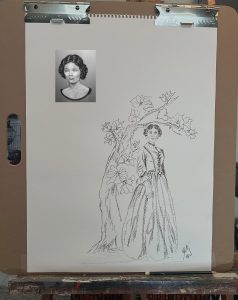
When I sculpt a portrait, I am always looking for more than physical resemblance.
I want to find the person beneath the features.
With Charlotte, I wanted the sculpture to communicate strength, dignity, intelligence, and quiet determination. Her story told me that she was a woman who had the courage to participate in building something much larger than herself.
Her inheritance was used to purchase the half league of land along Buffalo Bayou in 1836 that would become the foundation of the City of Houston. She went on to live in Houston for more than half a century, building a life and legacy connected to the growth of the city.
The more I learned about her, the more important it became to me that the sculpture should not feel like a distant historical figure.
I wanted people to be able to look into her face and feel that there was a woman there.
That is one of the things I love most about sculpture. Bronze is solid and enduring, but the process of creating it begins with something very human—my hands working in clay, trying to understand another person’s story.
 From Clay to Bronze
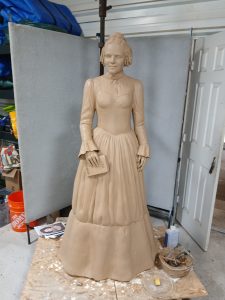
I began Charlotte in clay, slowly building her form and developing her portrait.
Sculpture is an intimate process. You spend countless hours looking at a face, making small adjustments, stepping back, looking again, and then changing something that may only be a fraction of an inch.
With a historical portrait, those decisions become even more important because there is always a balance between what you know and what you must interpret as an artist.
Once I felt that I had captured the woman I had come to know through my research, the sculpture began its transformation into bronze through the traditional lost-wax casting process.
This is a process I have spent much of my career learning and practicing. I don’t simply send my sculpture away to become a bronze. I have a deep understanding of the entire process—from the original sculpture and mold-making to casting, chasing, finishing, and patination.
There is something incredibly special about watching a figure that began as a piece of clay become a permanent work of bronze.
The material changes, but the spirit of the sculpture remains.
The Unveiling
The finished sculpture was unveiled by the Greater Houston Women’s Chamber of Commerce in the garden of the historic Julia Ideson Building at the Houston Public Library.
The timing made the occasion even more meaningful. The unveiling took place during Women’s History Month, while the Julia Ideson Building was celebrating its centennial.
It felt like the right place and the right moment to recognize Charlotte.
The event brought together people who care deeply about Houston and its history, including Houston Mayor John Whitmire and Suzan Deison, Founder, President, and CEO of the Greater Houston Women’s Chamber of Commerce.
Charlotte was no longer only a name in a history book. She was standing there in bronze.
Giving Charlotte a Face
What touched me most about this project was the opportunity to help people see Charlotte Baldwin Allen in a new way.
History often remembers names, dates, buildings, and events. Sculpture allows us to remember the people behind them.
Charlotte was a real woman who lived, dreamed, worked, made decisions, and helped shape the future of a place that would become one of the country’s great cities.
I hope that someone walking through the garden of the Julia Ideson Building will see her sculpture and stop.
I hope they become curious.
I hope they ask, “Who is she?”
And then I hope they discover her story.
Because that is what I believe sculpture can do. It can take someone who has been forgotten, overlooked, or known only through a few lines in a history book and make them present again.
A Woman Worth Remembering
Creating Charlotte Baldwin Allen’s sculpture was a privilege I will always treasure.
As an artist, I am grateful for the opportunity to use my hands and my craft to tell stories. And as a woman, I found something especially meaningful in creating a monument to another woman whose contributions deserve to be remembered.
Charlotte helped shape Houston.
My role was to help give her a face.
And now, through bronze, she has a place where generations of Houstonians can see her, learn about her, and remember her.
That is one of the greatest gifts sculpture can give an artist.
To take a story from the past and give it a lasting presence in the future.