


Bike to the Future
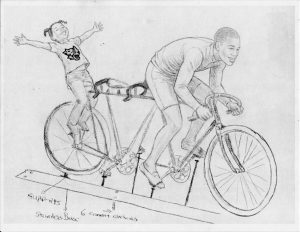 This is the original sketch for the sculpture
The Story Behind My Sculpture of Major Taylor
There are some people whose stories deserve to be remembered—not simply because of what they accomplished, but because of what they made possible for those who came after them.
Marshall “Major” Taylor was one of those people.
As I began creating this sculpture, I found myself thinking less and less about simply making a statue of a great cyclist and more about creating a tribute to a man who refused to let the limitations placed upon him determine how far he could go.
That is the heart of Bike to the Future.
Major Taylor was born in 1878 and became one of the greatest bicycle racers of his generation. In 1899, he became the world champion in cycling, and he was the first African American world champion in the sport. By the height of his career, he was one of the most famous athletes in the world.
But his story is about so much more than winning races.
Major Taylor competed during a time when racism and segregation were deeply embedded in American life. He was denied opportunities, barred from races, refused service at hotels and restaurants, and subjected to racial abuse. Yet he continued to race. He continued to train. He continued to push forward.
And he won.
What strikes me most about Major Taylor is not simply how fast he could ride a bicycle. It is the strength of character it took to keep moving forward when the world around him was constantly telling him that he did not belong.
He chose to keep going.
That is what I want this sculpture to communicate.
A Man Who Rode Beyond His Time
When I think about Major Taylor, I imagine the moment when a cyclist looks down the road and sees nothing but open space ahead.
The road doesn’t tell you what is waiting for you.
You simply have to ride.
Major Taylor rode into a future that did not yet exist.
He opened doors that others would eventually walk through. His accomplishments challenged the assumptions of his time, and his life became part of the much larger story of African Americans breaking barriers in American sports. The Smithsonian describes Taylor as having “sprinted through the color barrier” in professional bicycle racing.
That idea stayed with me as I worked on the sculpture.
Bike to the Future is not meant to be a monument only to the past. It is about the future.
It is about the young person who sees Major Taylor and realizes that the road ahead can be different.
It is about courage.
It is about perseverance.
It is about refusing to stop when the path becomes difficult.
And it is about understanding that sometimes one person’s determination can change what is possible for generations to come.
Bringing Major Taylor Into Bronze
As a sculptor, I have always believed that a sculpture should do more than reproduce someone’s likeness.
It should tell a story.
When I work with a live model, I am looking not only at anatomy and proportion, but at gesture, movement and emotion. With a historical figure like Major Taylor, I have to go beyond the physical likeness and try to understand the spirit of the person I am sculpting.
For me, the bicycle is an essential part of that story.
The bicycle represents movement and freedom. It represents speed, determination and the ability to move forward under your own power.
Major Taylor’s bicycle carried him around the world, but in a larger sense, it carried him beyond the expectations that had been placed upon him.
That is why I chose the title Bike to the Future.
The words are simple, but the idea behind them is much bigger.
Major Taylor didn’t just race toward a finish line.
He helped move history forward.
The Meaning Behind the Sculpture
I want people who see this sculpture to feel something.
I want a young cyclist to see it and feel inspired.
I want someone who has never heard of Major Taylor to become curious enough to learn his story.
I want people to see the determination in his face and the movement of his body and understand that they are looking at someone who refused to be defined by the barriers in front of him.
And perhaps most importantly, I want people to think about their own road ahead.
We all encounter obstacles. We all reach moments when the future is uncertain.
Sometimes the only thing we can do is keep moving.
Major Taylor understood that.
His life reminds us that the road forward is not always easy, and it is not always fair—but that does not mean we stop riding.
From History Into the Future
There is something especially meaningful about creating this sculpture in bronze.
Bronze has a permanence that few materials possess. It can withstand weather, time and generations of people passing by.
That makes it the perfect material for a story like Major Taylor’s.
A bicycle is constantly moving.
Bronze stands still.
In this sculpture, those two ideas come together.
The cyclist is captured in a moment of movement, but the sculpture itself is meant to endure.
Major Taylor’s race may have ended more than a century ago, but his story is still moving forward.
That is what I hope Bike to the Future will do.
I hope it helps carry Major Taylor’s story into the future.
I hope it reminds us that progress is made by people willing to move forward when it would be easier to stop.
And I hope that when someone looks at this sculpture years from now, they don’t simply see a champion cyclist from another era.
I hope they see possibility.
Because Major Taylor did more than win races.
He showed us how far a person can go when courage, determination and hope are stronger than the barriers standing in the way.
And now, through bronze, I have the privilege of helping his story ride forward into the future.